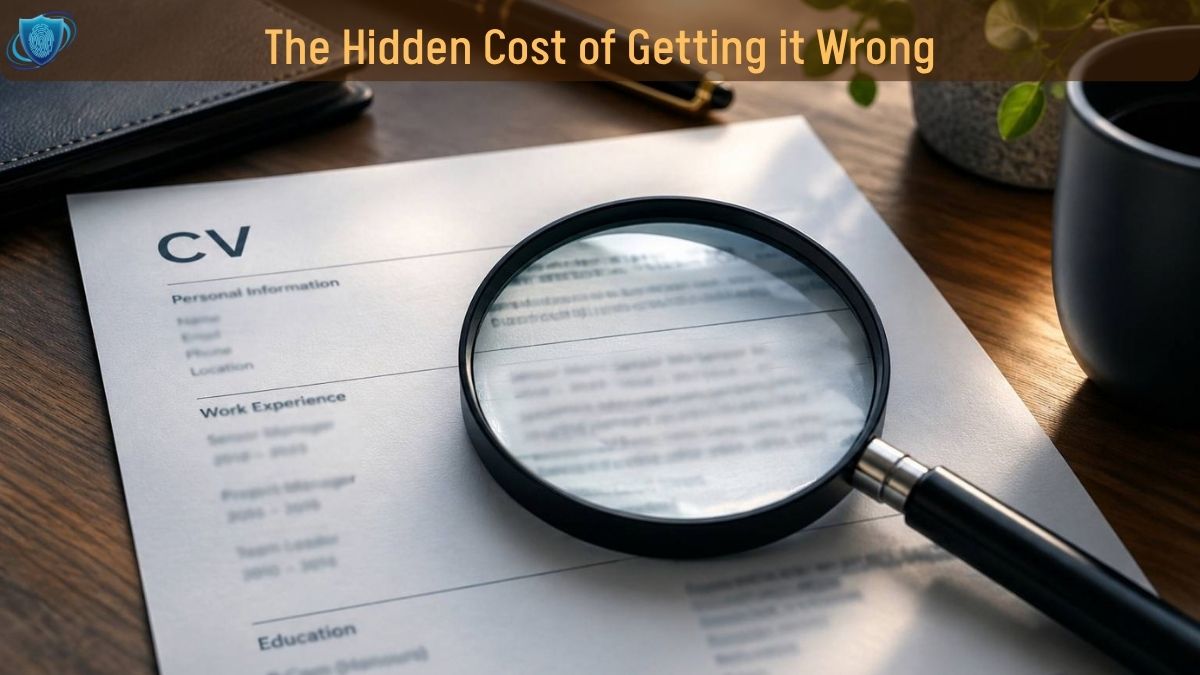
Magnifying glass held over the “Employment History” section of a CV on a wooden desk, with a pen, notebook, small plant and coffee cup nearby.

The Hidden Cost of Getting it wrong


What a R2.9 Million Judgment Teaches Us About the Value of Background Checks

In 2016, V&A Waterfront dismissed a senior executive after uncovering that significant parts of her employment history were not what she had claimed. The matter eventually went to the Labour Court, and in September 2026, judgment was handed down: the former employee was ordered to pay almost R2.9 million in damages, plus interest and legal costs.

It’s a striking figure, and it made headlines for that reason. But the number isn’t really the story.

The more useful question is what happened before the executive was ever offered the job — and what a thorough verification process might have uncovered before the appointment was made.

A different era of checking

It’s worth remembering that the hiring decision was made in 2015, and the screening landscape has changed considerably since then.

Many verification processes that can now be initiated and completed electronically were more manual at the time. Employment history, qualifications, identity and other credentials could still be verified, but doing so often involved more individual follow-up, paperwork and time.

That doesn’t mean proper screening was impossible in 2015. It wasn’t.

It means that the tools available today make it considerably easier to conduct checks quickly, consistently and at scale.

And that distinction matters.

Because the most important lesson from this case isn’t that technology failed. It’s that verification matters.

some things have never needed technology

Here’s what’s particularly interesting about this case: one of the most relevant forms of due diligence doesn’t depend on sophisticated technology at all.

A reference check — contacting a previous employer and verifying what a candidate has told you — has been possible for as long as employers have been hiring people.

The method is simple: make the call, ask the right questions, verify the dates and role, and pay attention to discrepancies between what has been presented and what can actually be confirmed.

In this case, the court found that the candidate had made material misrepresentations about her previous employment, including the circumstances in which previous roles had ended. The damages awarded reflect the court’s view that these misrepresentations were what led to her being employed in the first place.

That’s a powerful reminder that verification isn’t a modern invention made possible by better software.

It’s a discipline.

And the more senior the role, the greater the potential consequences when the information presented during recruitment isn’t accurate.

What money can't undo

The judgment awarded the complainant almost R2.9 million in damages, but it is important to understand what that figure represents.

Just over R1 million related directly to the fraudulent misrepresentations that induced the company to employ her. The remainder related to losses arising from the engagement of two consultants during her employment, in circumstances where the court found that her conduct in engaging them was fraudulent and in breach of her duties.

That distinction doesn’t weaken the lesson. If anything, it strengthens it.

A recruitment decision doesn’t happen in isolation. When a senior appointment goes wrong, the consequences can extend well beyond the initial hiring decision.

A company can recover money.

But it’s much harder to recover the months of disruption, the strain on the people who have to manage the fallout, the time spent investigating what went wrong, or the erosion of trust that comes from discovering that a senior hire’s history wasn’t what it appeared to be.

Some costs never show up neatly on a balance sheet.

That’s the real argument for doing the check before the offer goes out, not after something goes wrong.

It’s not about assuming the worst of every candidate.

It’s about making an informed decision based on information that has been verified.

Where this leaves us today

The tools available now make thorough screening easier, faster and more scalable than it was a decade ago.

But technology doesn’t replace judgement — and it doesn’t replace the fundamentals.

A glowing interview and an impressive CV are not the same thing as a verified history. The two can look identical from the outside and still be worlds apart.

None of this is about assigning blame for what happened in this particular case. It’s about recognising the value of doing the due diligence before the appointment is made.

Some things about good hiring haven’t changed since the 1980s.

What’s changed is how quickly, and how completely, those things can now be verified.

At Credence Screening Enterprise, this is exactly the kind of due diligence we help businesses get right — employment history, qualifications, and background checks, done thoroughly and brought together quickly, so a hiring decision is based on what’s verified rather than what’s assumed.

Ready to hire with confidence? Get in touch to find out how we can help.

Share This Article

Leave a Comment

Subscribe
Notify of
guest
0 Comments
Oldest
Newest Most Voted

Recent Posts

Dark blue graphic with a crack running across the title: “No Band-Aid for this one.” Subtitle: “What a mis-hire can cost a small business.” Credence shield logo in the corner.

No Band-Aid for This One

Sam thought he had it covered: a good interview, a warm reference, a quick look online. Four months later, the cracks began to show. A story about what a mis-hire can cost a small business.

Read More »

Background Checks: The Evolution — Enter AI

“The algorithm decided” turns out to be about as strong a defence as “I didn’t know” ever was. In 2023, a company paid out for teaching its hiring software to automatically reject applicants over a certain age. In South African law, there’s already a rule about exactly this. Part 4 looks at what happens when the checking itself stops being done by a person at all — and whether that’s a problem worth worrying about, or one we’ve quietly already solved.

Read More »

Background Checks: The Evolution — The Digital Leap

By 1996, over half of large companies were already running background checks digitally — a strange jump for an industry that had barely existed a decade before. Once checking could happen in minutes instead of weeks, doing it slowly stopped looking like a limitation, and started looking like a choice. Part 3 traces how that shift happened, and what it quietly changed about what “reasonable care” means.
Read More »

Background Checks: The Evolution — The Liability Question

In 1908, a court held an employer responsible for a death at work — not for what an employee did, but for what the employer already knew and chose to ignore. That idea, that you’re responsible for what you should have known, turns out to be older than the background check industry itself. Here’s where it began.
Read More »

Vet Before You Let

Most landlords decide who lives in their property during a fifteen-minute viewing. Here’s why that’s not enough — and what South African law actually requires before you can undo the decision.

Read More »
0
Would love your thoughts, please comment.x
()
x