
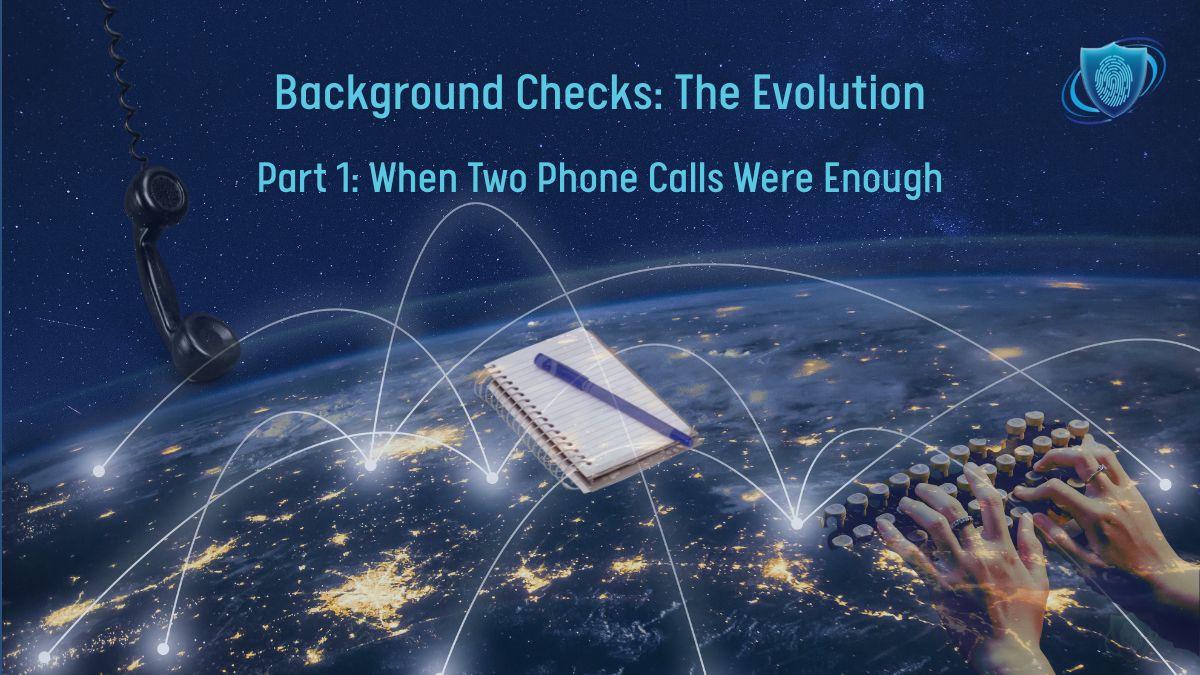

Rotary telephone, notebook and pen, and hands typing on a keyboard glowing over a world map — background checks evolving from phone calls to global verification

BACKGROUND CHECKS: THE EVOLUTION

Part 1 – When Two Phone Calls Were Enough

Back in the day, there were two fairly simple ways of finding a job.

You could respond to a newspaper ad. Send your CV, get invited for an interview, and, if they liked you, you got the job.

Or you could register with an employment agency. If you were suited to something on their books, they’d send you for an interview. If the customer liked you, you got the job.

The routes were different, but there was one thing they had in common: before you got the job, someone picked up a phone and called two people, maybe three, who knew you.

A previous boss. A neighbour who’d vouch for you. Someone with a title after their name.

A day or two after you started, HR called you into a small office, asked for your ID and your tax number, and that was that.

It wasn’t naive. It was just how it was done. Trust travelled by word of mouth, and word of mouth moved fast.

Today, hiring someone can involve an employment agency, a screening company, a separate verification agency and, in some corners of the world, AI making decisions at both ends — hire and fire — with no human in the loop at all.

So what happened in between?

Did people become harder to trust? Or did we simply gain the ability to check — and once we could, start feeling like we had to?

“You could be liable for a bad hire with almost no reliable means of seeing it coming.”

Here’s the part that surprised us when we went looking: that world didn’t quietly evolve into this one. It was interrupted by two things happening at roughly the same time.

The First Thing That Changed: The Law

Long before anyone had built anything resembling a background-check industry, courts had already started asking employers an uncomfortable question: what if you should have known?

The idea that an employer could be held legally responsible for who they hired is well over a hundred years old — older than the industry itself by decades. For most of that time, there was a gap between what the law expected of employers and what they actually had any practical way of checking.

You could be liable for a bad hire with almost no reliable means of seeing it coming.

That is an important part of the story, because the responsibility placed on employers was beginning to change. It was no longer enough to say, I didn’t know. In some circumstances, the question became whether you should have known.

But the law wasn’t the only thing putting pressure on the old system.

The Second Thing That Changed: The World Got Bigger

Word-of-mouth vetting worked because it relied on small, overlapping circles of people.

The person vouching for you usually had something to lose if they were wrong. And the person hiring you often knew someone who knew you, or knew your family. There were connections, reputations and consequences built into the system.

That worked well enough for a long time.

Then the world of work got bigger.

Workforces grew. People began moving for work more than they had before. Employers were hiring people they had never met, from places they didn’t know, with no shared connections to rely on.

“Someone who knows someone” stopped being a filter you could count on.

And that left employers with a problem. The law was increasingly saying, in effect, that they needed to take reasonable care over who they hired, while the old methods of finding out who someone was were becoming less useful.

Somewhere in that gap — a legal standard with nowhere to stand, and a trust network too small for a bigger world — an industry was born.

When Background Checking Became An Industry

In the United States, this shift eventually got written into regulation directly.

The Fair Credit Reporting Act of 1970 formalised third-party background checks into a real, regulated marketplace, and several of the biggest names in the industry today trace their roots to that period.

South Africa’s path looked different. POPIA is our version of “here’s how this must be done properly and fairly”. But the underlying pressure was much the same: the old system was breaking down before a new one existed to replace it.

So the two-phone-call world didn’t fade gently into this one.

It got pulled out from under employers before there was anything solid to stand on instead — which is probably part of why, for a good while, background checks felt like an awkward, half-trusted formality rather than the standard they are today.

Trust Didn’t Disappear. It Changed Shape

It’s tempting to look at the history of background checks as a story about things getting stricter. More rules. More paperwork. More boxes to tick before someone can start a job.

But that’s not really what happened.

The underlying problem has stayed remarkably consistent.

An employer still wants to know, with reasonable confidence, that the person joining their business is who they say they are. A family hiring someone to work in their home wants the same thing. The technology has changed. The processes have changed. The amount of information available to us has changed.

The need for trust hasn’t.

As our series progresses, we’ll trace that journey chapter by chapter — from a world where two phone calls were enough, to one where you could be hired, and fired, by an AI, with no human ever in the loop. Part 2, The Liability Question, picks up right where this one leaves off.

It’s a bigger story than “things got stricter.” It’s the story of how trust changed shape.

For now, here’s what hasn’t changed: the goal was always the same — knowing, with reasonable confidence, that the person joining your home or business is who they say they are.

That’s still the whole point of a background check.

We’ve just found a faster way to get there.

Our flagship criminal background check needs nothing more than an ID number and consent — no fingerprints, no waiting around, and typically just hours rather than days.

SHARE THIS ARTICLE

Recent Posts

Background Checks: The Evolution — Enter AI

“The algorithm decided” turns out to be about as strong a defence as “I didn’t know” ever was. In 2023, a company paid out for teaching its hiring software to automatically reject applicants over a certain age. In South African law, there’s already a rule about exactly this. Part 4 looks at what happens when the checking itself stops being done by a person at all — and whether that’s a problem worth worrying about, or one we’ve quietly already solved.
Read More »

Background Checks: The Evolution — The Digital Leap

By 1996, over half of large companies were already running background checks digitally — a strange jump for an industry that had barely existed a decade before. Once checking could happen in minutes instead of weeks, doing it slowly stopped looking like a limitation, and started looking like a choice. Part 3 traces how that shift happened, and what it quietly changed about what “reasonable care” means.

Read More »

Background Checks: The Evolution — The Liability Question

In 1908, a court held an employer responsible for a death at work — not for what an employee did, but for what the employer already knew and chose to ignore. That idea, that you’re responsible for what you should have known, turns out to be older than the background check industry itself. Here’s where it began.

Read More »

Share your thoughts

5 1 vote
Article Rating
Subscribe
Notify of
guest
0 Comments
Oldest
Newest Most Voted
0
Would love your thoughts, please comment.x
()
x